The System
One SystemFive LayersZero Manual Intervention
From raw scanner data to clinical-grade metabolic intelligence — an end-to-end AI Agentic Architecture that replaces the entire conventional MRS workflow.
Architecture
Vertically Integrated. Purpose-Built. Agentic.
METLiT’s architecture is not a general-purpose AI model applied to MRS. It is a purpose-built system where specialized AI Agents are designed for each processing stage and vertically integrated on top of MRS physics first principles.
Acquisition Gateway
Receives data acquired via standard protocols and normalizes the format.
Unified processing of raw data formats from GE, Philips, and Siemens. No special sequences required — works with data you are already acquiring.
Signal Processing Agent Layer
Autonomously assesses and optimizes spectral signal quality.
Phase correction, frequency alignment, baseline fitting, and artifact detection — each performed autonomously by dedicated Agents. Automates every step that previously required manual preprocessing while maintaining physics-based consistency.
Quantification Engine
Deep learning engine separates and quantifies 17 individual metabolites.
A deep neural network trained on decades of MRS physics knowledge separates individual metabolite signals from overlapping spectra. Bayesian approach quantifies uncertainty for each result, enabling clinical confidence assessment.
Clinical Intelligence Agent Layer
Performs contextual reasoning on quantified metabolic profiles.
Normal range comparison, anomaly detection, disease-specific pattern matching, and institution-specific reference data — all autonomously executed by the Clinical Reasoning Agent.
Delivery & Integration
Generates institution-customized reports and integrates with existing systems.
Delivered as a cloud-native SaaS platform with PACS integration, API access, and automated audit-ready documentation.
Clinical-grade metabolic intelligence — delivered in seconds
Clinical Pipeline
Turning Science into Clinical Impact
METLiT is building a portfolio of MRS-based clinical applications. Each project targets a specific unmet need where metabolic insight can change patient outcomes.
Finding Treatable Dementia: NPH
Normal Pressure Hydrocephalus (NPH) is a cause of dementia treatable with a simple shunt surgery. However, its symptoms closely resemble Alzheimer’s and Parkinson’s, making accurate differentiation extremely difficult.
3.7%[5]
of the population aged 65+ has NPH
49%[6]
specificity of MRI alone for NPH
90.5%[4]
accuracy of MRS-based shunt outcome prediction
3 min
additional MRS scan time on existing MRI
For Patients
No hospitalization required
Outpatient MRI workflow — no 3-7 day CSF tap admission
Non-invasive diagnosis
Standard MRI scan + 3 min MRS — no lumbar puncture
Faster path to treatment
From symptom to surgical decision in days, not weeks
For Institutions
No specialist dependency
AI-automated — no MRS Ph.D. or NPH subspecialist required
Fits existing MRI workflow
Standard protocols, all major vendors, just +3 min scan time
New diagnostic revenue stream
Unlock MRS capability already built into every scanner
Workflow Comparison
From Weeks of Uncertainty to Minutes of Clarity
Conventional Process
NPH Symptom Onset
Gait disturbance · Cognitive decline · Urinary incontinence
MRI Scan
Specificity only 49%⁶
Specialist Referral
Transfer to hospital with NPH specialists
Hospitalization + CSF Tap Test
3-7 day admission · Sensitivity 29.7%⁷
Shunt Surgery Decision
Prolonged overall timeline
With METLiT
NPH Symptom Onset
Gait disturbance · Cognitive decline · Urinary incontinence
MRI + MRS Scan
Just +3 min added to existing MRI
AI Automated Analysis
METLiT Agentic System
Metabolic Profile Report
17 metabolites quantified + uncertainty
Shunt Surgery Decision Support
No hospitalization · Outpatient workflow
The Platform
METLiT MRS Analytics
(MAIA)
An intuitive clinical interface. No MRS expertise required.
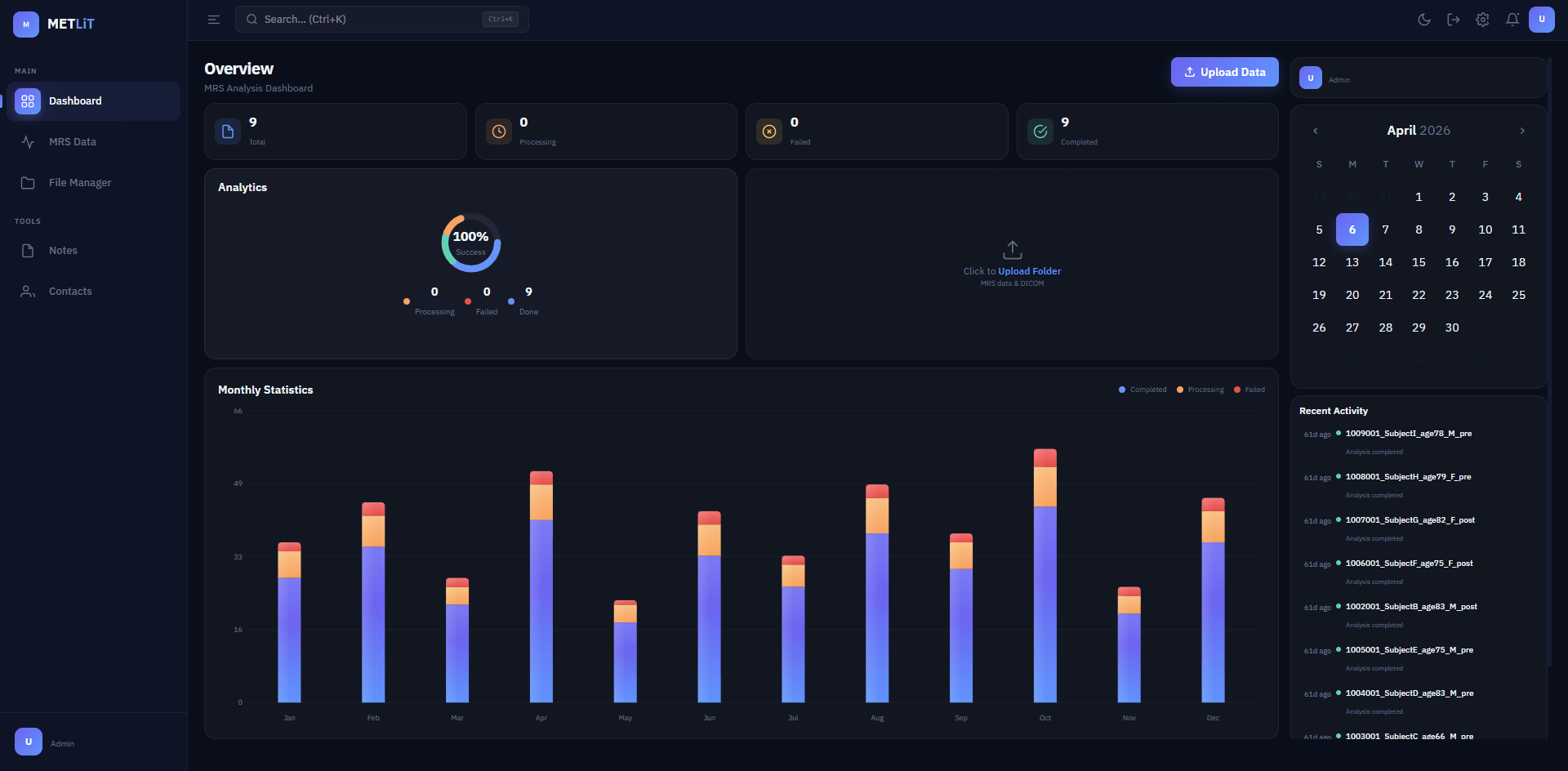
Screenshot 1 / 7
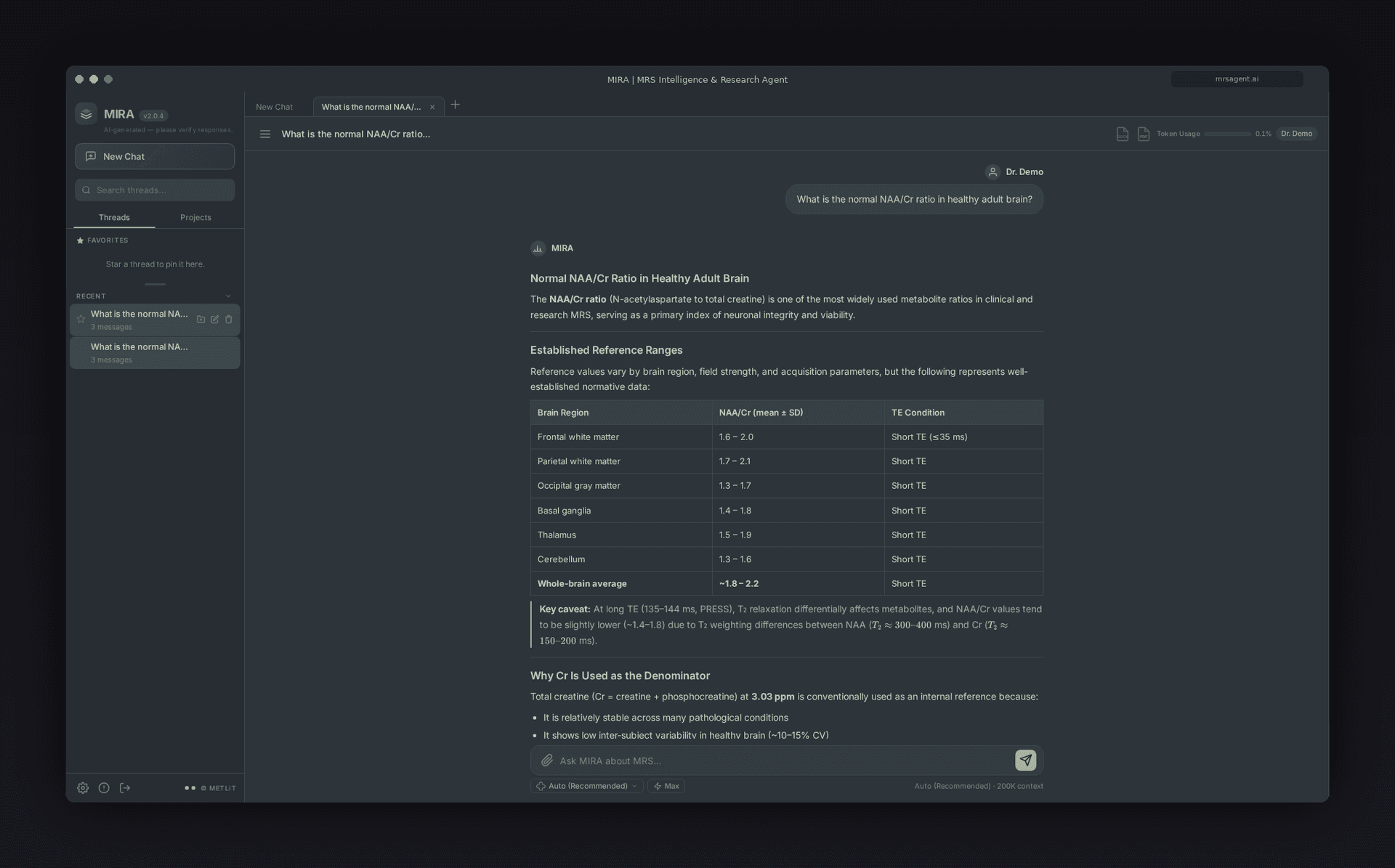
The Agent
METLiT MRS Agent
(MIRA)
An AI-native conversational interface for MRS interpretation. Ask questions, get answers — powered by the full Agentic pipeline.
Deployment
Configured for Your Context
Hospitals & Clinics
- ·Cloud-based AI-native MRS platform
- ·Fully automated processing & quantification
- ·Intuitive clinical interface — no MRS expertise required
- ·Research-backed metabolite reference ranges
“Deploy without changing your existing MRI workflow”
Pharma & Research
- ·MRS clinical study design consulting
- ·Advanced analytics with 17-metabolite resolution
- ·Patient stratification & selection support
- ·Longitudinal monitoring & treatment response tracking
“Dramatically more efficient research data analysis”
Imaging & Device Partners
- ·MRI vendor-neutral compatibility
- ·White-label API integration
- ·Modular architecture for scanner console/viewer embedding
“Unlock the latent value of MRS capability already built into scanners”
See the system for yourself.
References (7)
- [1]Lee HH, Kim H. Magn Reson Med 82.1 (2019): 33-48.
- [2]Lee HH, Kim H. Magn Reson Med 84.4 (2020): 1689-1706.
- [3]Lee HH, Kim H. Magn Reson Med 88.1 (2022): 38-52.
- [4]Shiino A, et al. J Neurol Neurosurg Psychiatry. 2004;75(8):1141-8.
- [5]Andersson J, et al. PloS one 14:e0217705. 2019.
- [6]Chen CH, et al. J Clin Neurosci. 2022;105:9-15.
- [7]Rydja J, et al. Fluids Barriers CNS 18, 18. 2021.